Feature

    Stocks and ETFs are the easy part. What about the rest?

    Bonds, real estate, crypto, pension pillars, private deals β€” Portfellow tracks every asset class with the same rigor, so your net worth isn't a guess.

    Multi-Asset Support in Portfellow

    Most trackers quietly give up on half your assets

    The moment your portfolio goes beyond stocks and ETFs, most tools start approximating β€” or just leave things out.

    Real estate becomes a static guess

    A rental property gets typed in as a flat number, with no rental income, no real tracking β€” just a placeholder that goes stale.

    Pension pillars live in a separate app entirely

    Estonian Pillar II and III holdings never show up alongside your brokerage account, so your real net worth is always split across logins.

    Bonds get reduced to a single price

    No coupon schedule, no maturity date β€” just a number that tells you what it's worth today and nothing about what it will actually pay you.

    Key highlights

    Stocks, ETFs, and mutual funds

    Bonds and fixed income with coupon tracking

    Real estate with rental income

    Cryptocurrency with live pricing

    Cash equivalents and alternative investments

    Deep dive

    Every asset class, one dashboard

    Stocks, ETFs, index funds, bonds, real estate, crypto, cash β€” most portfolio trackers handle one or two of these well and treat the rest as an afterthought. Portfellow treats all of them as first-class citizens, with the same performance tracking, analytics, and reporting no matter what you hold.

    That means your true net worth β€” the number that actually matters β€” isn't scattered across three apps and a spreadsheet just because your portfolio doesn't fit neatly into one broker's category list.
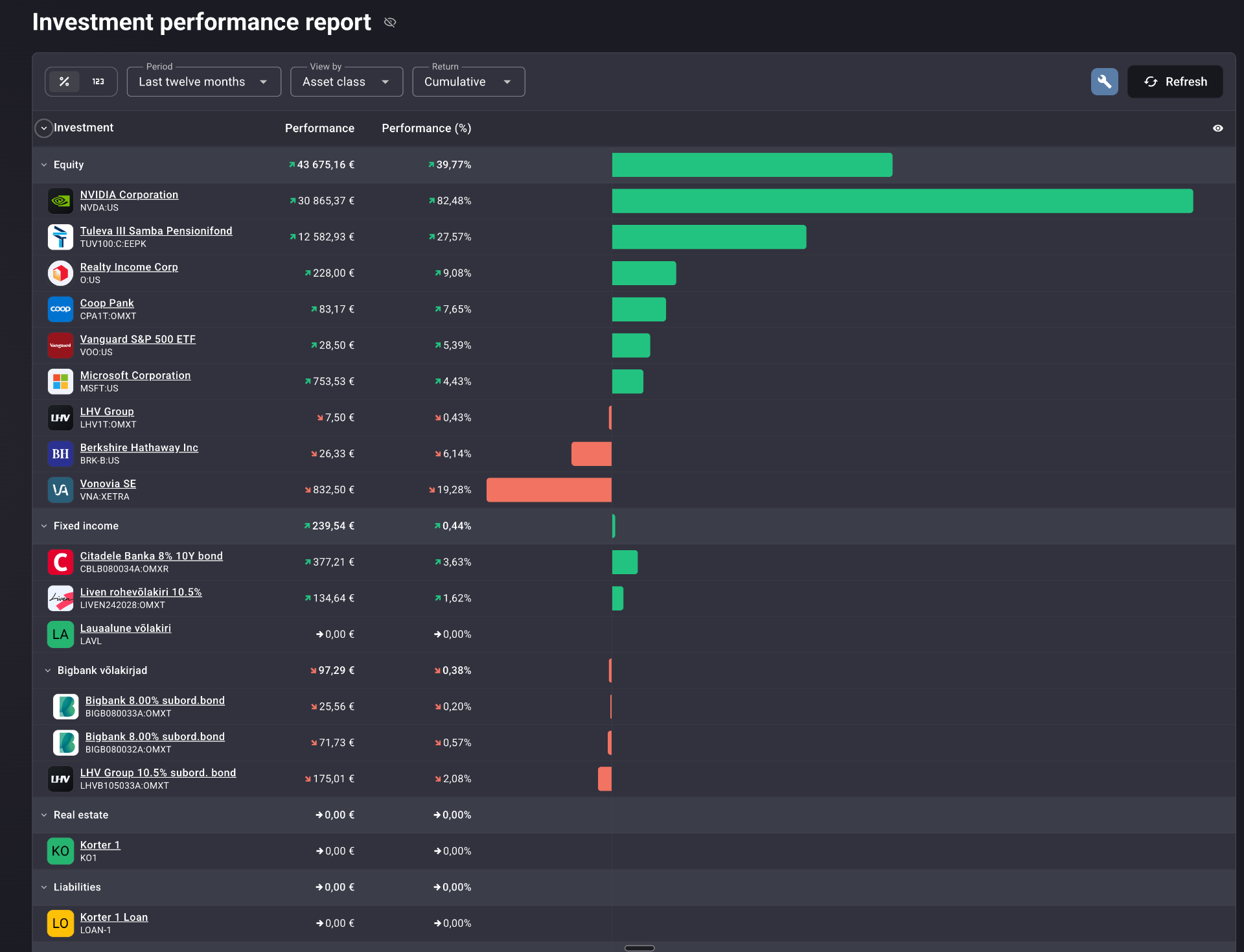
    Multi-asset portfolio broken down by asset class in Portfellow

    Real estate and bonds, properly modeled

    Real estate positions track rental income alongside property valuation, so a rental property shows up as the income-generating asset it actually is, not just a static number. REITs are tracked as the listed securities they are.

    Bonds and other fixed income track coupon payments and maturity dates, so you can see not just what a bond is worth today, but what it's actually going to pay you and when.

    Including what other trackers can't

    Estonian Pillar II and III pension funds, private deals, cash equivalents, money market funds β€” the assets that don't fit a typical brokerage app get the same tracking as everything else.

    That's what makes the net worth number in Portfellow actually complete, instead of an approximation that quietly excludes half of what you own.

    How it works

    1. 1

      Add any asset

      Connect a broker for automatic tracking, or add real estate, private deals, or anything else manually.

    2. 2

      Portfellow applies the right math

      Each asset class gets the tracking logic that actually fits it β€” coupons for bonds, rental income for property, live pricing for crypto.

    3. 3

      See one true net worth

      Every asset class rolls up into a single, accurate net worth number β€” no more adding up numbers from five different apps.

    Built for

    The multi-asset investor

    Holds more than stocks and ETFs β€” bonds, real estate, maybe some crypto β€” and wants it all tracked with the same rigor.

    • Coupon and maturity tracking for bonds
    • Rental income tracking for real estate
    • Live pricing for major cryptocurrencies

    The beyond-the-brokerage investor

    Has money in places a typical broker app has never heard of β€” pension pillars, private deals, cash equivalents.

    • Pillar II and III pension fund tracking
    • Manual tracking for private and alternative assets
    • One true net worth across everything

    Frequently asked questions

    Get a net worth number you can actually trust.

    Every asset class, tracked with the same rigor β€” stocks, bonds, real estate, crypto, and pension pillars, all in one true total.